For many organisations, the biggest challenge with Virtual Reality training isn’t deciding whether to use it, it’s avoiding VR shelf-ware. We regularly see organisations invest in VR hardware first, then search for existing experiences to run on it. The headsets arrive, the demos look impressive, but the underlying training challenge hasn’t been clearly defined. The result is often VR shelf-ware: technology that sits unused, underused, or fails to deliver meaningful impact because it was never aligned to a real learning need.
VR has moved well beyond the novelty phase. Across education, healthcare, construction, logistics and manufacturing, immersive learning is now a proven tool for building skills, changing behaviour and improving performance. But like any powerful tool, its effectiveness depends entirely on how and why it is used.
The most successful immersive training programmes don’t start with hardware or platforms. They start by understanding the problem to be solved, and only then selecting the immersive approach that best fits that challenge. Once that foundation is in place, organisations typically find themselves choosing between two distinct routes into immersive learning: 360° narrative VR or game engine–built VR.
Two routes into immersive learning
At XR Studios, we often describe immersive training as having two clear entry points, each designed to achieve different learning outcomes.
360° narrative VR
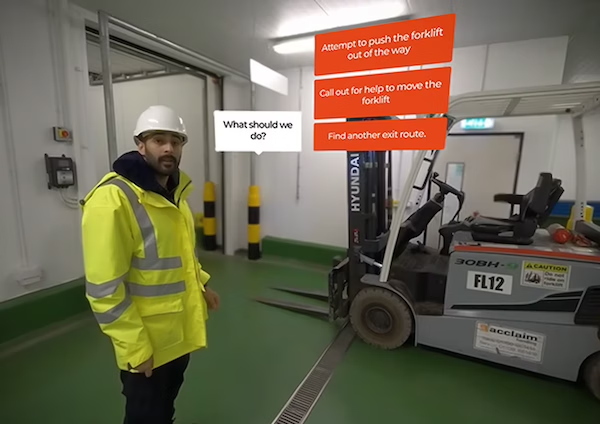
360° narrative VR is filmed using real-world cameras placed inside real environments — such as a hospital ward, factory floor, construction site or classroom. Learners are locked to the camera’s position, meaning they cannot move freely through the space. Instead, they look around naturally as events unfold around them.
Interactivity in this format is choice-based, not physical. At key moments in the experience, learners are asked to make decisions that influence the direction or outcome of the narrative.
This makes 360° VR best understood as an interactive story, rather than a simulation.
Game engine–built VR
Game engine–built VR is created entirely in 3D using real-time engines such as Unity or Unreal Engine.
In these experiences, learners are active participants. They can:
- Move freely through virtual environments
- Interact with objects and tools
- Follow procedures step by step
- Practise tasks repeatedly
Rather than observing events, learners learn by doing. These experiences function more like simulators than films, allowing people to rehearse skills in a safe, controlled and repeatable way.
Both approaches sit under the same VR umbrella, but they serve very different purposes.
The strength of 360° narrative VR: realism and relatability
There is something uniquely powerful about being placed inside a real environment with real people.
For many learners, 360° VR feels instantly authentic. They recognise the setting. They recognise the situations. And they recognise themselves in the story. This makes narrative VR particularly effective for:
- Behavioural change
- Awareness and compliance
- Leadership and people management
- Safeguarding and well-being
- Customer interaction and communication
In these areas, success is driven less by physical interaction and more by judgement, empathy and decision-making. From a practical perspective, 360° VR also offers a fast and cost-effective entry point into immersive learning. Production timelines are shorter, deployment is straightforward, and content can be rolled out consistently across large learner groups. It’s often the right choice when organisations need:
- Speed to impact
- Consistency of message
- Strong emotional engagement
- Scalable deployment
The power of game engine–built VR: learning by doing
Where narrative VR excels at storytelling, game engine–built VR excels at capability building. These environments allow learners to practise tasks that may be:
- High-risk
- High-cost
- Rare
- Logistically difficult
...without real-world consequences. As a result, game engine–built VR is particularly valuable for:
- Technical and engineering training
- Medical and healthcare simulation
- Equipment operation
- Manufacturing and logistics workflows
- Emergency response and safety drills
In these experiences, learners don’t just make decisions; they perform actions. They repeat procedures, refine techniques and build confidence through hands-on practice. Because everything is digital, learner performance can be tracked, assessed and improved over time. While game engine–built VR typically requires a greater upfront investment, it also offers longevity. These platforms can be expanded, updated and adapted as training needs evolve, making them well-suited to long-term skills development.
It’s not about better - it’s about better fit
One of the most common misconceptions we encounter is that one VR approach is inherently superior to the other.
In reality, they solve different problems. If your priority is:
- Changing attitudes
- Building awareness
- Supporting decision-making
- Delivering consistent training at scale
Then, 360° narrative VR is often the most effective route. If your priority is:
- Developing hands-on skills
- Simulating complex procedures
- Building muscle memory
- Measuring competency
Then game engine–built VR becomes the natural choice. Avoiding VR shelf-ware comes down to making this distinction early, before technology decisions are locked in.
Why more organisations are choosing a blended approach
Increasingly, the most effective immersive training strategies don’t choose one path; they combine both.
We’re seeing strong results when organisations use:
- 360° VR to introduce context, challenge assumptions and build understanding
- Game engine–built VR to follow up with practical application and skills development
This creates a complete learning journey, where learners understand the situation, practise the skills, and apply their knowledge with confidence.
Making the right decision for your organisation
The best immersive training experiences don’t start with technology; they start with purpose.
Before choosing an approach, it’s worth asking:
- What do we want learners to do differently?
- Are we changing behaviour or building capability?
- Do we need emotional impact or technical mastery?
- Is this a rapid rollout or a long-term training platform?
Clear answers to these questions help ensure VR becomes a strategic tool, not another piece of unused kit.
Our perspective at XR Studios
At XR Studios, we design and deliver both 360° narrative VR and game engine–built immersive experiences because we know that immersive learning is not one-size-fits-all. Some organisations require rapid and scalable engagement. Others need deep, high-fidelity simulation. Many need both. Our role is to help our clients' and their organisations avoid VR shelf-ware by aligning immersive technology with real training outcomes, so VR doesn’t just look impressive, but delivers measurable impact.
Where?
Who Сan Join?
How to Take Part?
Speakers
Countdown to the Event
The clock is ticking! Don’t miss your chance to join us – the event starts soon.
1
Months
1
Days
1
Hours
1
Minutes
1
Seconds