Ports never really stop. Ships berth through the night, cranes and forklifts keep moving, and contractors and visitors come and go all day. That makes maritime training one of the hardest things to deliver well, especially the hands-on emergency drills that matter most. You cannot set off a fire alarm on a live quay every time a new starter joins, and classroom slides only go so far. Virtual reality offers a practical middle ground. Here is how VR lets port and logistics teams rehearse fire safety and evacuations safely and on demand, what we learned building a simulation for the Thames Freeport, and how to start with a small pilot.
Why traditional maritime training struggles on live port sites
Safe on paper. Harder in practice.
Most port safety training follows a familiar pattern: an induction presentation, a site walk if time allows, a quiz, and a signature on a form. It ticks the compliance box, but it rarely gives people the chance to practise what to do when something actually goes wrong.
There are good reasons for that. A full evacuation drill on a working port interrupts vessel operations, moves people away from critical tasks and costs real money in lost time. Running drills near moving plant, stacked containers or fuel stores carries its own risk. Shift patterns mean the people who need the training are rarely in the same place at the same time. And ports host a constantly changing mix of employees, agency staff, hauliers, contractors and visitors, each needing a consistent level of health and safety training before they set foot on site.
The result is what we call the Rehearsal Gap: the distance between knowing a procedure and having actually practised it under pressure. Most people can tell you where the muster point is. Far fewer have walked there while an alarm is sounding and a forklift is crossing their path.
What a VR emergency evacuation simulation looks like
Real decisions. No real danger.
VR training simulations close that gap. A headset puts trainees inside a realistic version of the site, without any of the real-world risk.
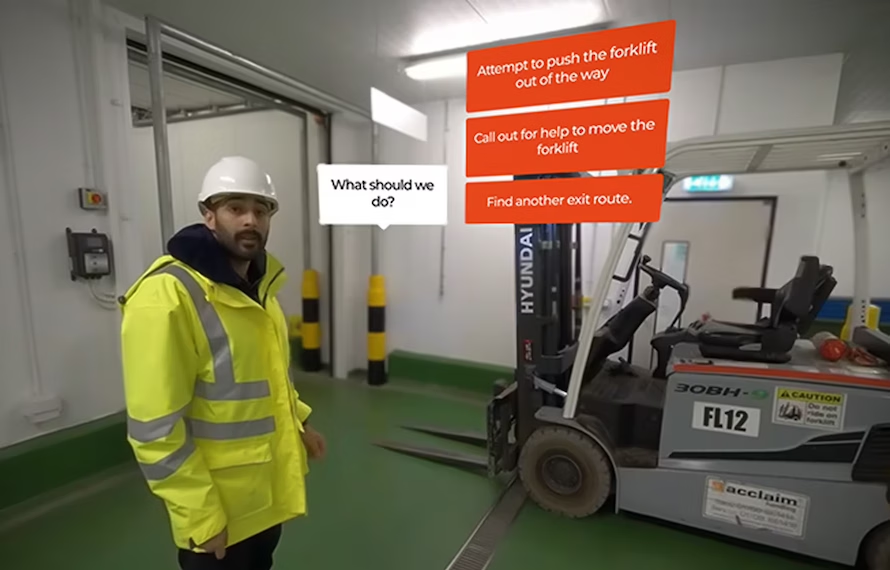
A typical emergency evacuation scenario works like this. The trainee starts in a familiar part of the site. An alarm sounds. From there, they make the decisions that matter: whether to raise the alarm, which route to take, what to do about hazards in their path, and where to report once they are clear. In the simulation we built for the Thames Freeport, a worker in hi-vis and a safety helmet puts questions to the trainee (that's you) at key moments.
Because the scenario is decision-based, a wrong choice does not end in injury. It ends in feedback and learning. The trainee sees the consequence, understands why it matters, and tries again. That repetition at scale is what a one-off drill cannot offer. VR simulations also help marine and logistics companies reduce the risk of serious injury and fatalities by allowing staff to practise spotting hazards, making safe decisions and responding correctly before facing a real emergency.
VR safety training is not the same as a maritime simulator. A maritime simulator, in the traditional sense, is usually a full bridge or engine room setup used to train officers in navigation and ship handling. VR safety training is lighter, more portable and focused on the procedures every person on site needs to know, from fire safety training to evacuation routes and hazard awareness. It can run on standalone headsets, so sessions can happen in a training room, a site office or a welfare cabin.
How we built fire safety training for the Thames Freeport
The Thames Freeport is close to home for us. Our studios are on Canvey Island in the Thames Estuary, just along the river from the freeport's port sites, so we understand the scale and pace of the operations these teams train for.
The challenge. Delivering fire safety training at a live port site is logistically complex and poses safety risks. The freeport needed a solution that offered the same quality of training without depending on access to the physical environment.
The solution. We developed an immersive 360° VR simulation that guides trainees through a realistic, decision-based emergency evacuation scenario. It builds confidence and knowledge in a safe environment, and it sits alongside a port health and safety eLearning package we also created for the freeport. That package is SCORM-compliant (SCORM is the standard that lets a course plug into your learning management system and track completions), so staff, contractors and visitors get a consistent induction.
The results.
- 24/7 access to training
- 100% safe and risk free
- 2x increase in engagement
Stuart Rimmer, Deputy Chief Executive at Thames Freeport, said: "XR Studios’ expertise and quality of work were great. They created an engaging, interactive SCORM package for Health & Safety, as well as a fully immersive Virtual Reality (VR) Emergency Evacuation simulation. Both solutions should significantly boost participant engagement and knowledge retention. Pilots of innovative solutions such as these are set to transform onboarding and training within the Thames Freeport."
You can see more of this work, along with our wider approach to training on our dedicated marine and logistics industry page.
Where VR fits alongside certified maritime training
VR complements and augments accredited training. It does not replace it.
Certified courses, such as STCW Basic Training for seafarers (the international standard covering firefighting, sea survival and first aid) or the statutory fire safety and health and safety training your site requires, remain essential. They set the standard, and VR should never be presented as a shortcut around them.
Where VR adds value is in the space around those courses:
- Site-specific rehearsal. A generic certified course cannot show a trainee your muster points, your access routes or your particular hazards. A simulation built around your site can.
- Refreshers between courses. Skills fade. A short VR scenario every few months keeps procedures fresh without pulling teams off shift for a full day.
- Consistent inductions. Contractors, hauliers and visitors arrive with very different levels of experience. A standard VR module means everyone sees the same scenario and gets the same key messages.
- Wider logistics training. The same approach works for warehouses, distribution centres and yards, wherever moving vehicles, heavy loads and busy people share the same space.
Combined with SCORM eLearning which records completions in your learning management system (LMS), VR becomes part of an auditable training record rather than a standalone novelty.
How to start small with a VR pilot
Start small. Measure honestly.
You do not need to rebuild your whole training programme to find out whether VR works for your site. A focused pilot tells you far more than a big launch.
- Pick one high-risk, hard-to-practise scenario. Fire evacuation is a natural starting point, because it matters to everyone on site and is the hardest drill to run for real.
- Agree what success looks like before you build. Completion rates, assessment scores, engagement, confidence levels or time saved. Decide early, so you can measure honestly afterwards.
- Plan where the headsets will live and who looks after them. One of the most common reasons VR projects stall has nothing to do with the content. The headsets end up in a cupboard. We have written about avoiding VR shelf-ware and the habits that keep a programme in use.
- Run it across shifts and roles. Include new starters, experienced staff and contractors, so you see how different groups respond.
- Review, refine and scale. Use the results to decide which scenario comes next.
Our 4D Production Process (Discover, Define, Develop, Deliver) is built for this kind of measured start, and our VR training simulations are developed in-house, under one roof, from the first site visit to the finished headset experience.
Ready to Rehearse Safety Without the Risk?
If your teams work on a port, or a busy logistics site, VR gives them the practice live drills cannot, and it is safe, consistent and available on any shift.
Request a demo and we will walk you through a VR evacuation scenario and talk through what a pilot could look like for your site.
Where?
Who Сan Join?
How to Take Part?
Speakers
Countdown to the Event
The clock is ticking! Don’t miss your chance to join us – the event starts soon.
1
Months
1
Days
1
Hours
1
Minutes
1
Seconds