

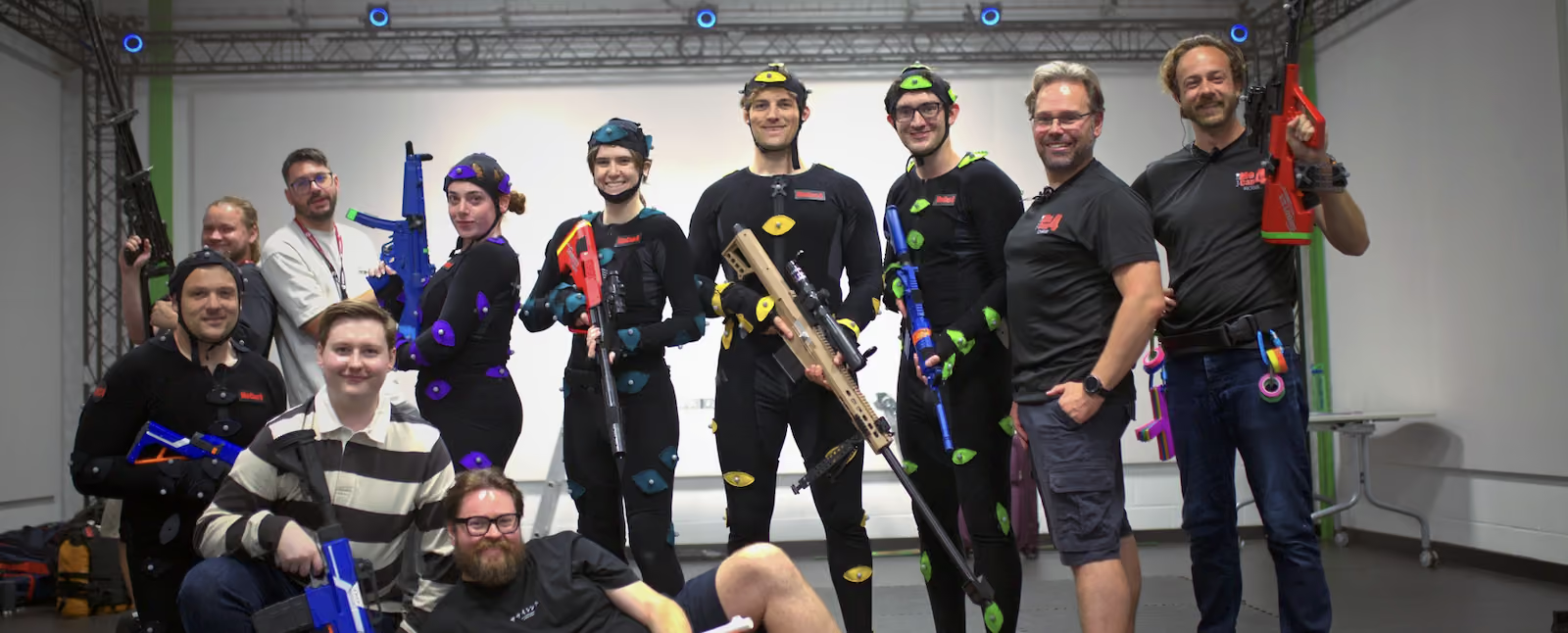
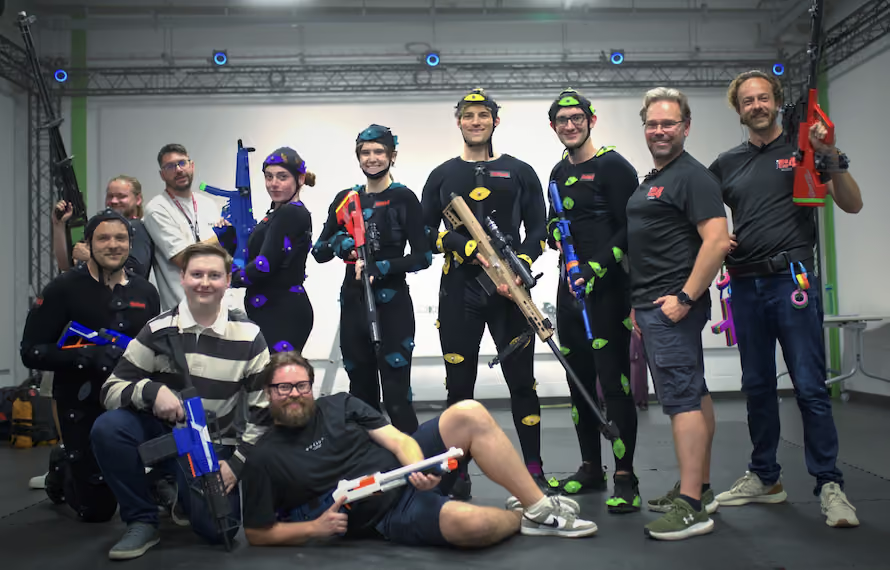
Watch a game character sprint, flinch or break into a smile, and the motion probably started with a real person in a studio, not an animator drawing every frame by hand. So, what is motion capture? It is the process of recording a real performer's movement and mapping it onto a digital character, so the result moves the way people actually move. Film studios, games developers and, increasingly, training and healthcare teams use it to bring characters, avatars and simulations to life faster and more believably than hand animation alone. Here is how it works, the systems behind it, and what a session at a professional motion capture studio actually involves.
What motion capture is and how it works
Motion capture, or mocap, records the movement of a real person and turns it into digital animation data. A performer wears markers, sensors or simply moves in front of specialist cameras, and the system tracks the position of their joints many times a second. That data builds a moving skeleton, which an artist then attaches to a 3D character model, whether that is a game hero, a film creature, or a training avatar.
The result is animation with the weight, timing and small imperfections of a real performance, things that are hard and slow to recreate by hand. That is why motion capture has become the standard route into high-quality character animation for anyone working at scale, from AAA games studios to smaller teams who need realistic movement without a full animation department.
Optical, inertial and markerless motion capture compared
Not all motion capture systems are equal, and the right one depends on the budget, the production and the level of precision needed.
Optical motion capture uses reflective markers on a suit and a ring of cameras around a dedicated volume, such as our motion capture studio in Essex. Multiple cameras triangulate each marker's position, which makes optical systems the most accurate choice for film, games and any project where every finger twitch matters.
Inertial motion capture uses a wearable suit packed with motion sensors instead of cameras. It is more portable, works outdoors or on location, and needs no fixed capture volume, though it is generally less precise than optical for fine detail.
Markerless motion capture uses computer vision to track a performer's movement from ordinary video, with no suit or markers at all. It is the most accessible option and improving fast, but still trails marker-based systems for accuracy on complex or fast movement.
Most professional productions still lean on optical systems like OptiTrack for anything that needs to hold up on screen, and use inertial or markerless capture where portability matters more than pixel perfect precision.
Bringing film and game characters to life
Motion capture in film has been behind some of the most memorable digital characters in modern cinema for over two decades. Creatures, non-human leads, and hyper-realistic human characters all rely on a real actor's performance being carried through into the final render, not built frame by frame from scratch.
Motion capture for games works the same way, and it has become the default route for combat, movement, and cutscene animation at any serious game studio. The underlying data comes from real physical performance rather than keyframed guesswork, so characters run, fall, and react the way people actually do. It also speeds up production considerably. Once a session is captured, animators are refining real movement instead of creating it from nothing, which is why motion capture animation now sits at the centre of most AAA production pipelines.
Facial capture and performance capture
Body movement is only half the story. Facial motion capture records the small, fast movements of a performer's face, usually with a head mounted camera or a dedicated facial rig and maps them onto a character's expressions. When body and facial capture are combined, the result is called performance capture, and it is what allows a digital character to carry genuine emotion rather than a generic animated expression. This is the technique behind the most convincing non-human and digitally enhanced characters audiences have seen on screen, and it is increasingly used for realistic avatars in training and virtual production too.
Motion capture beyond entertainment
Motion capture is not just a film and games tool. The same systems that track a stunt performer can track a warehouse worker's lifting technique, a surgeon's hand movement, or a trainee's posture on a factory line, which makes it a genuinely useful tool for sport science, ergonomics, and immersive training simulations. This is where our studio-as-a-service model under one roof matters. The same OptiTrack setup that captures a game character can capture movement data for a training simulation, then feed straight into the eLearning or XR development side of a project, without switching vendors or studios.
Getting started with motion capture
You do not need a full studio budget to start using motion capture. Indie developers and animators are increasingly booking short sessions to capture a handful of key moves, such as a signature attack, a walk cycle, or a hero animation, rather than trying to build an entire animation library by hand. The main things to think about before a session are:
- What you actually need. A short list of specific moves, captured well, is more useful than hours of loosely planned footage.
- The performer. A stunt coordinator or trained performer will give cleaner, more usable data than someone improvising in front of the cameras for the first time.
- What happens after capture. Raw motion data still needs cleaning up and retargeting onto your character rig, so factor that time in alongside the shoot itself.
A good studio will talk you through all of this at the booking stage, so you arrive with a clear plan rather than working it out on the day.
What a session at our OptiTrack studio looks like
A typical session starts with fitting the performer's suit and calibrating the cameras, so the system recognises every marker correctly before recording begins. From there, it is largely about repetition, capturing a run of a movement several times so the animation team has options in the edit.
"People are often surprised by how much of the final performance survives all the way through to the finished character," says Andy Martin, Studio Lead at XR Studios, whose background spans VFX, games and education.
"Good motion capture is not about fixing a performance afterwards. It is about giving the performer the freedom to actually act, and letting the technology keep up with them." says Peps Circelli, Managing Director of XR Studios, who has over twenty years experience working across theatre, television, film and marketing.
Recently, we discussed the importance of motion capture within the gaming industry during XR Studios Presents: The Rockstar King, our uncensored fireside chat with Jamie King, co-founder of Rockstar Games. If you want to see the kind of conversation our studio attracts from legends across the games industry, then this recording is defintely worth a watch!
Ready to Dive into XR?
Whether you are an indie developer, film director, or a training lead exploring animated characters for the first time, our Essex based motion capture studio gives you access to industry standard equipment and an expert team who can guide you through it end-to-end. Book now or contact us to arrange a visit of our OptiTrack Motion Capture studio for yourself.
Where?
Who Сan Join?
How to Take Part?
Speakers
Countdown to the Event
The clock is ticking! Don’t miss your chance to join us – the event starts soon.
1
Months
1
Days
1
Hours
1
Minutes
1
Seconds